
A N C I E N T ★ L O R E
Vampires
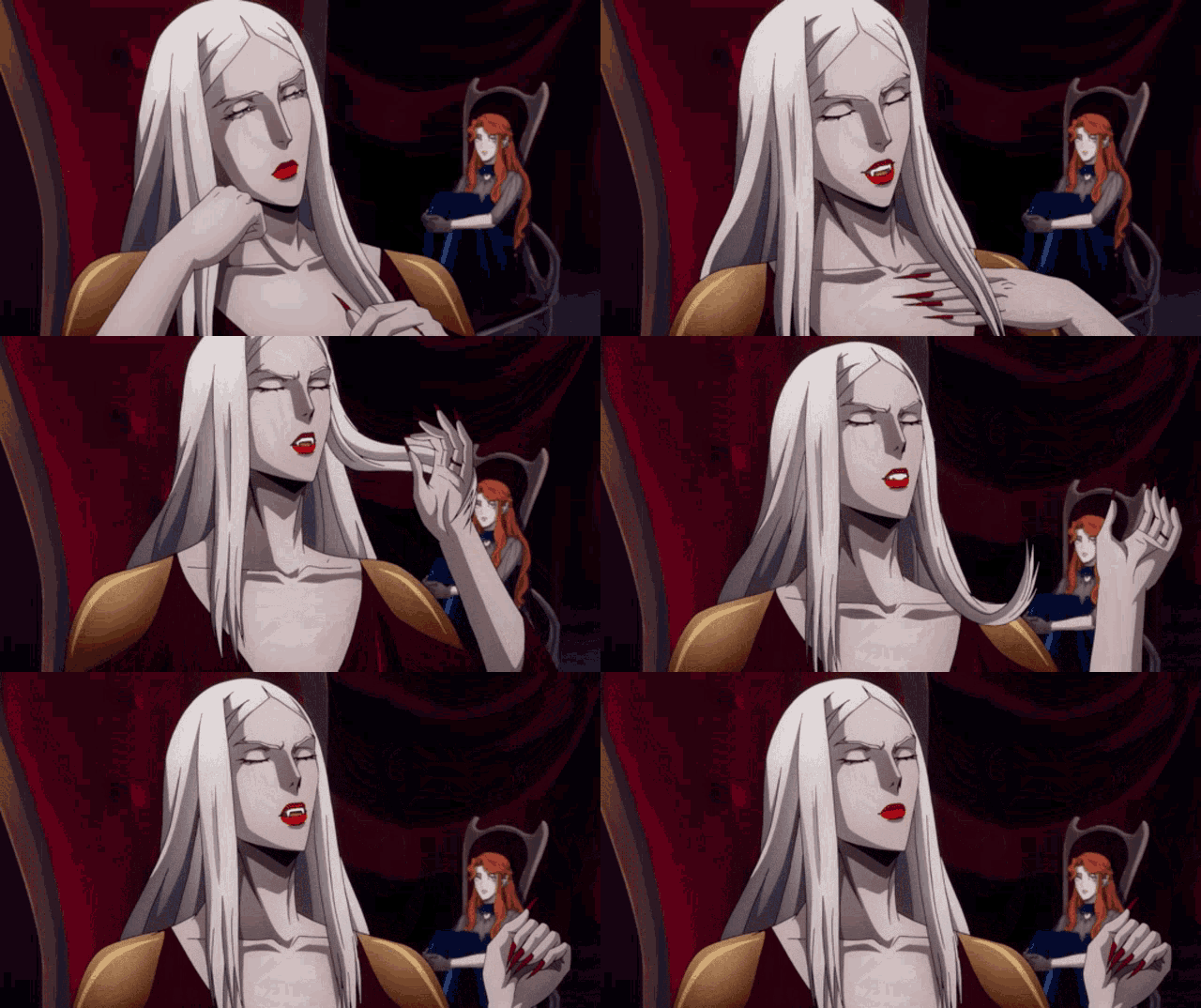
★Vampire folklore and beliefs in blood-drinking monsters date back over 4,000 years. Originating with ancient Mesopotamian and Babylonian mythology of the Ekimmu. The concept evolved through ancient Greek and Roman stories of night demons before the modern aristocratic vampire crystallized in 18th-century Eastern Europe.
★Vampire, in popular legend, a creature, often fanged, that preys upon humans, generally by consuming their blood. Vampires have been featured in folklore and fiction of various cultures for hundreds of years, predominantly in Europe, although belief in them has waned in modern times.
The origins of the myth branch into specific periods and categories:
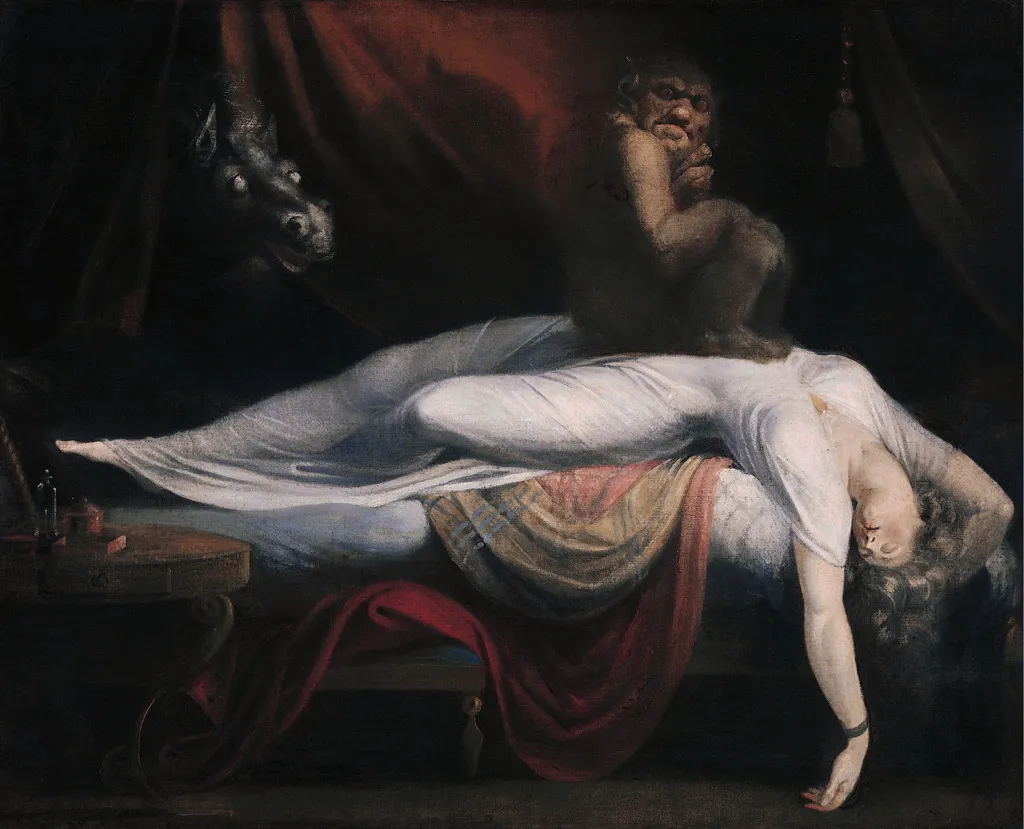
Henry Fuseli: The Nightmare, 1781
- Ancient Roots (~2000 BCE): The earliest recorded vampire-like legends stem from ancient Mesopotamia and Babylonia Wikipedia. Stories featured ekimmu—restless, demonic spirits of the dead that returned to drain the life and blood of the living Medium.
- Classical Antiquity (~1200 BCE to 300 CE): Ancient Greek and Roman cultures told tales of the Lamia (snake-like women who preyed on youths) and the Stryge (a night demon that drank blood).
- The Slavic "Revenant" (~11th to 15th Century): The traditional "undead corpse" that rises from the grave originated in Eastern Europe Origins. This era was heavily influenced by mass disease and political upheaval, leading to superstitions about decomposing bodies.
- The "Vampire Epidemic" (18th Century): The word "vampire" finally entered the Western lexicon in the 1720s and 1730s after military officials in the Habsburg Empire investigated and documented local folklore of peasants exhuming and staking bodies to stop perceived outbreaks.
- Modern Gothic Fiction (19th Century): The suave, aristocratic bloodsucker was popularized by 19th-century English literature, starting with John Polidori's The Vampyre (1819) and culminating in Bram Stoker's Dracula (1897)
Vampires are "Evil" mythological beings who roam the world at night searching for people whose blood they feed upon. They may be the best-known classic monsters of all. Most people associate vampires with Count Dracula, the legendary, blood-sucking subject of Bram Stoker’s epic novel, Dracula, which was published in 1897. But the history of vampires began long before Stoker was born. It’s thought Bram Stoker named Count Dracula after Vlad Drăculea, also known as Vlad the Impaler. Vlad Drăculea was born in Transylvania, Romania. He ruled Walachia, Romania, off and on between 1448 and 1477.
Some historians describe him as a just—yet brutally cruel—ruler who valiantly fought off the Ottoman Empire. He earned his nickname because his favorite way to kill his enemies was to impale them on a wooden stake.
According to legend, Vlad Drăculea enjoyed dining amidst his dying victims and dipping his bread in their blood. Whether those gory tales are true is unknown. Many people believe these stories sparked Stoker’s imagination to create Count Dracula, who was also from Transylvania, sucked his victim’s blood and could be killed by driving a stake through his heart.
But, according to Dracula expert Elizabeth Miller, Stoker didn’t base Count Dracula’s life on Vlad Drăculea. Nonetheless, the similarities between the two are intriguing.
Characteristics
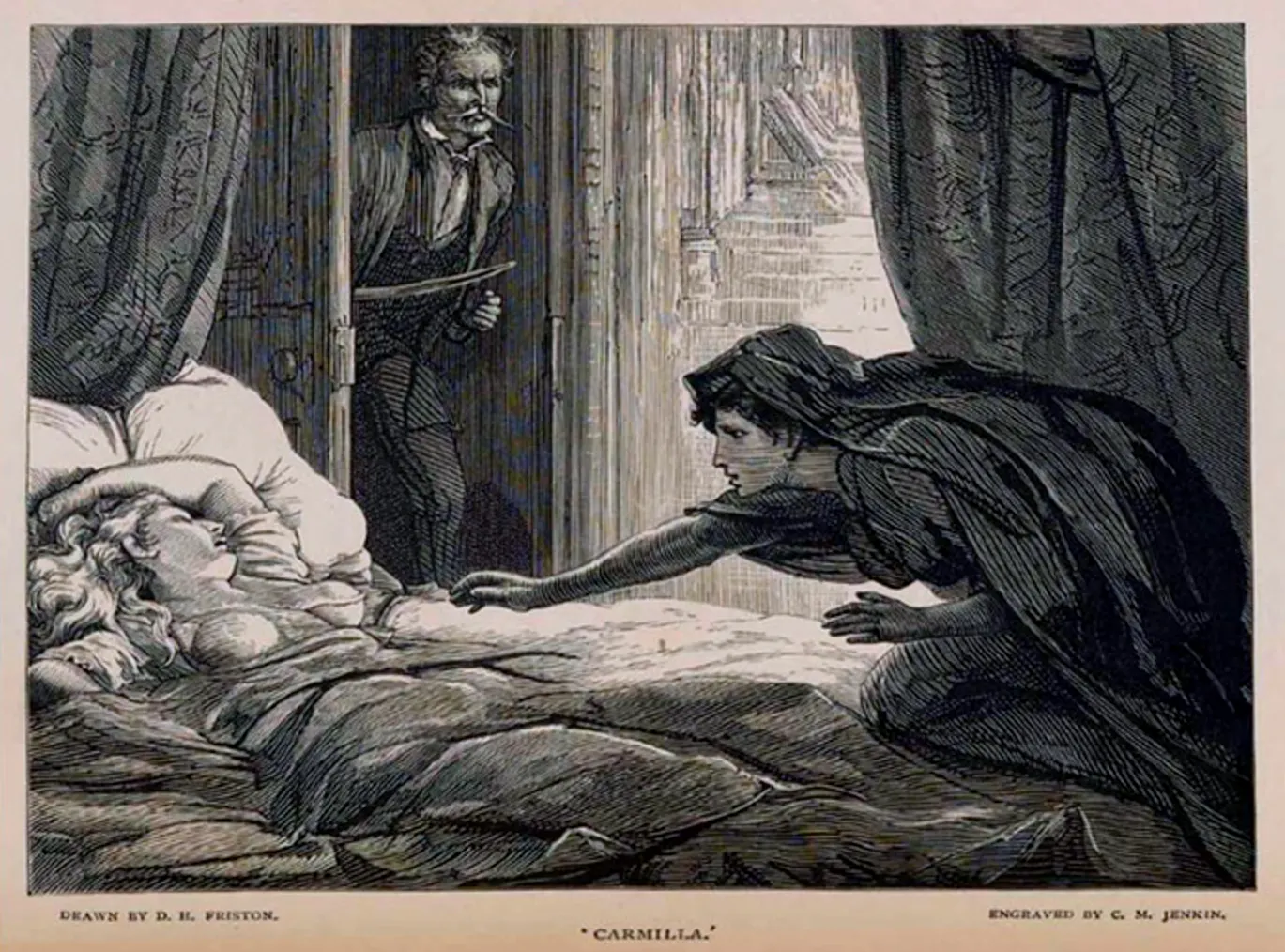
D.H. Friston & C.M. jenkin: Carmilla, 1872
Because there is a long history of walking corpses and bloodsucking ghouls in folklore, it is difficult to pin down a distinct set of characteristics consistently attributed only to vampires. Central to vampire myth, however, is the consumption of human blood or other essence (such as bodily fluids or psychic energy), followed closely by the possession of sharp teeth or fangs with which to facilitate this task. In most depictions, vampires are “undead”—that is to say, having been somehow revived after death—and many are said to rise nightly from their graves or coffins, often necessarily containing their native soil. Vampires are typically said to be of pale skin and range in appearance from grotesque to preternaturally beautiful, depending on the tale. Another frequently cited physical characteristic is the inability to cast a reflection or shadow, which often translates into an inability to be photographed or recorded on film.
A person may become a vampire in a variety of ways, the most common of which is to be bitten by a vampire. Other methods include sorcery, committing suicide, contagion, or having a cat jump over a person’s corpse. Some people believed that babies born with teeth or on Christmas or between Christmas and Epiphany were predisposed to becoming vampires. While vampires usually do not die of disease or other normal human afflictions, and they are indeed often said to have faster-than-normal healing capabilities, there are various methods for their destruction. The most popular of those include a wooden stake through the heart, fire, decapitation, and exposure to sunlight. Vampires are often depicted as being repelled by garlic, running water, or Christian implements such as crucifixes and holy water. In some stories vampires may enter a home only if they have been invited, and in others they may be distracted by the scattering of objects such as seeds or grains that they are compelled to count, thereby enabling potential victims to escape.
History
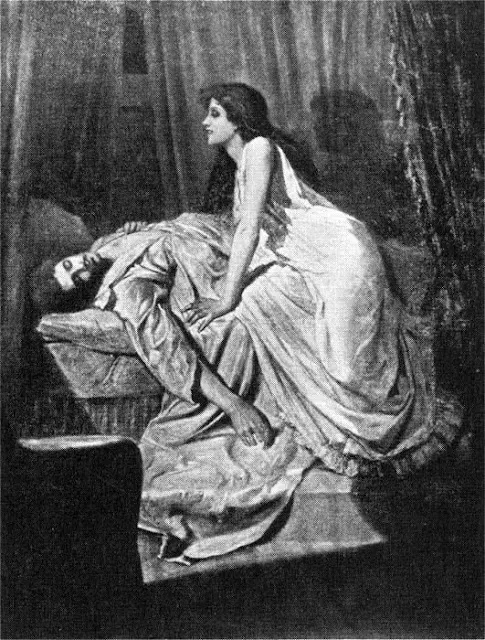
Philip Burne-Jones & Mrs. Patrick Campbell: The Vampire, 1897
Creatures with vampiric characteristics have appeared at least as far back as ancient Greece, where stories were told of creatures that attacked people in their sleep and drained their bodily fluids. Tales of walking corpses that drank the blood of the living and spread plague flourished in medieval Europe in times of disease, and people lacking a modern understanding of infectious disease came to believe that those who became vampires preyed first upon their own families. Research from the 20th and 21st centuries has posited that characteristics associated with vampires can be traced back to certain diseases such as porphyria, which makes one sensitive to sunlight; tuberculosis, which causes wasting; pellagra, a disease that thins the skin; and rabies, which causes biting and general sensitivities that could lead to repulsion by light or garlic.
Vampire myths were especially popular in eastern Europe, and the word vampire most likely originates from that region. Digging up the bodies of suspected vampires was practiced in many cultures throughout Europe, and it is thought that the natural characteristics of decomposition—such as receding gums and the appearance of growing hair and fingernails—reinforced the belief that corpses were in fact continuing some manner of life after death. Also possibly contributing to this belief was the pronouncement of death for people who were not dead. Because of the constraints of medical diagnosis at the time, people who were very ill, or sometimes even very drunk, and in a coma or in shock were thought dead and later “miraculously” recovered—sometimes too late to prevent their burial. Belief in vampires led to such rituals as staking corpses through the heart before they were buried. In some cultures the dead were buried facedown to prevent them from finding their way out of their graves.
The modern incarnation of vampire myth seems to have stemmed largely from Gothic European literature of the 18th and 19th centuries, about the time vampire hysteria was peaking in Europe. Vampiric figures appeared in 18th-century poetry, such as Heinrich August Ossenfelder’s “Der Vampyr” (1748), about a seemingly vampiric narrator who seduces an innocent maiden. Vampire poems began appearing in English about the turn of the 19th century, such as John Stagg’s “The Vampyre” (1810) and Lord Byron’s The Giaour (1813). The first prose vampire story published in English is believed to be John Polidori’s “The Vampyre” (1819), about a mysterious aristocrat named Lord Ruthven who seduces young women only to drain their blood and disappear. Those works and others inspired subsequent material for the stage. Later important vampire stories include the serial Varney, the Vampire; or, The Feast of Blood (1845–47) and “The Mysterious Stranger” (1853), which are cited as possible early influences for Bram Stoker’s Dracula (1897), and Théophile Gautier’s “La Morte amoureuse” (1836; “The Dead Lover”) and Sheridan Le Fanu’s Carmilla (1871–72), which established the vampire femme fatale.
Dracula is arguably the most important work of vampire fiction. The tale of the Transylvanian count who uses supernatural abilities, including mind control and shape-shifting, to prey upon innocent victims inspired countless works thereafter. Many popular vampire characteristics—such as methods of survival and destruction, vampires as aristocracy, and even vampires being of eastern European origin—were solidified in this popular novel and especially through its 1931 film adaptation starring Hungarian-born actor Bela Lugosi. The novel itself is thought by some to have been inspired in part by the cruel acts of the 15th-century prince Vlad III Dracula of Transylvania, also known as “the Impaler,” and Countess Elizabeth Báthory, who was believed to have murdered dozens of young women during the 16th and 17th centuries in order to bathe in or possibly drink their blood so as to preserve her own vitality.
Dracula in turn inspired the film Nosferatu (1922), in which a vampire was first depicted as being vulnerable to sunlight. Other aspects of the movie, however, were so similar to Stoker’s novel that his widow sued for copyright infringement, and many copies of the film were subsequently destroyed. For several decades the vast majority of vampire fiction, whether on page or stage or screen, showed the influence of Dracula. Both the novel and its film version spawned several direct sequels and spin-offs, including the film Dracula’s Daughter (1936) and a number of Hammer films, including Dracula (1958; also known as Horror of Dracula), which starred Christopher Lee in the title role. Vampires became popular characters in pulp magazines and appeared in stories such as the Sherlock Holmes tale “The Adventure of the Sussex Vampire” (1924). In 2009 the original author’s great-grandnephew Dacre Stoker and Ian Holt published a sequel called Dracula: The Un-Dead using notes and excisions from Dracula.
In the 20th century vampires began to turn from being depicted as predominantly animalistic creatures and instead displayed a broader range of human characteristics. Ray Bradbury explored the sympathetic portrayal of what can be thought of as “monsters,” including vampires, in “Homecoming” (1946), a story about a “normal” boy with a family of fantastical creatures. The popular American television soap opera Dark Shadows (1966–71) featured a lovelorn vampire, Barnabas Collins. In 1975 Fred Saberhagen published The Dracula Tape, a retelling of Stoker’s story from the misunderstood villain’s point of view. Vampire fiction entered a new era, however, with the sympathetic portrayal by Anne Rice in her novel Interview with the Vampire (1976). Rice’s book introduced the world to vampires that were brooding and self-loathing and squabbled like humans. While Rice’s vampires were more vulnerable emotionally than vampires previously had been, they were less vulnerable physically—susceptible only to daylight and fire and the death of the first of their kind—and possessed superhuman beauty, speed, and senses. Interview with the Vampire was highly popular and sparked a revival of vampire fiction that lasted into the 21st century, and subsequent vampire stories continued to use characteristics established by Rice. Rice herself wrote several more books in what subsequently became known as the Vampire Chronicles, some of which were later adapted for film.
The vampire as a misunderstood romantic hero picked up steam in the later part of the 20th century, particularly in the United States. In 1978 Chelsea Quinn Yarbro began publishing her series of Count Saint-Germain books, the main character of which is a vampire of moral character whose bite is an erotic experience. In many tales vampires are characterized as promiscuous, their appetite for human blood paralleling their sexual appetite. In 1991 Lori Herter published Obsession, one of the first vampire novels to be categorized as romance rather than science fiction, fantasy, or horror. Buffy the Vampire Slayer, a television show in which the title character has a star-crossed romance with a vampire, aired from 1997 to 2003. Vampire romances also appeared in the steamy HBO television series True Blood, based on Charlaine Harris’s Sookie Stackhouse book series. Vampire romance for teens gained popularity at the end of the 20th century and beginning of the 21st, with books such as the Vampire Diaries series by L.J. Smith and the Twilight Saga by Stephenie Meyer. The Twilight Saga, with its high-school romance and vampires that sparkle in the sun rather than bursting into flames, became a cultural sensation, ensuring a vampire trend for years to come. Vampire relationships of a different sort were explored in the novel Låt den rätte komma in (2004; Let the Right One In) by John Ajvide Lindqvist, in which the main characters are a perpetually childlike vampire and a young boy she befriends and helps fend off bullies. The book was adapted for film in Sweden in 2008 and in the United States as Let Me In in 2010.
Vampires also enjoyed popularity as unlikely action heroes. Blade, a half-vampire superhero who first appeared in comic books, was the focus of three films (1998, 2002, 2004). Another popular film series, Underworld (2003, 2006, 2009, 2012), explored an ongoing war between vampires and werewolves. Dracula himself (known instead as “Alucard”—Dracula spelled backward) even became an action hero in the Japanese manga and anime Hellsing. Angel, the vampire with a soul and the love interest of Buffy the Vampire Slayer’s title character, became the star of his own spin-off television series in which he acts as a private detective (1999–2004). And the tabletop role-playing game Vampire: The Masquerade (first published 1991)—which contributed words such as sire (a vampire’s progenitor) and embrace (the act of making a new vampire) to the vampire lexicon—allowed players to create their own vampire worlds and pit warring vampire factions against one another.
Although vampires had by the 20th century largely become creatures of fantasy, urban myths about vampires continued to persist. As late as the early 20th century, some villages in Bulgaria still practiced corpse impaling. In the 1960s and ’70s a vampire was believed to haunt Highgate Cemetery in London, and in the early 21st century rumours of vampires caused uproar in Malawi and England alike.
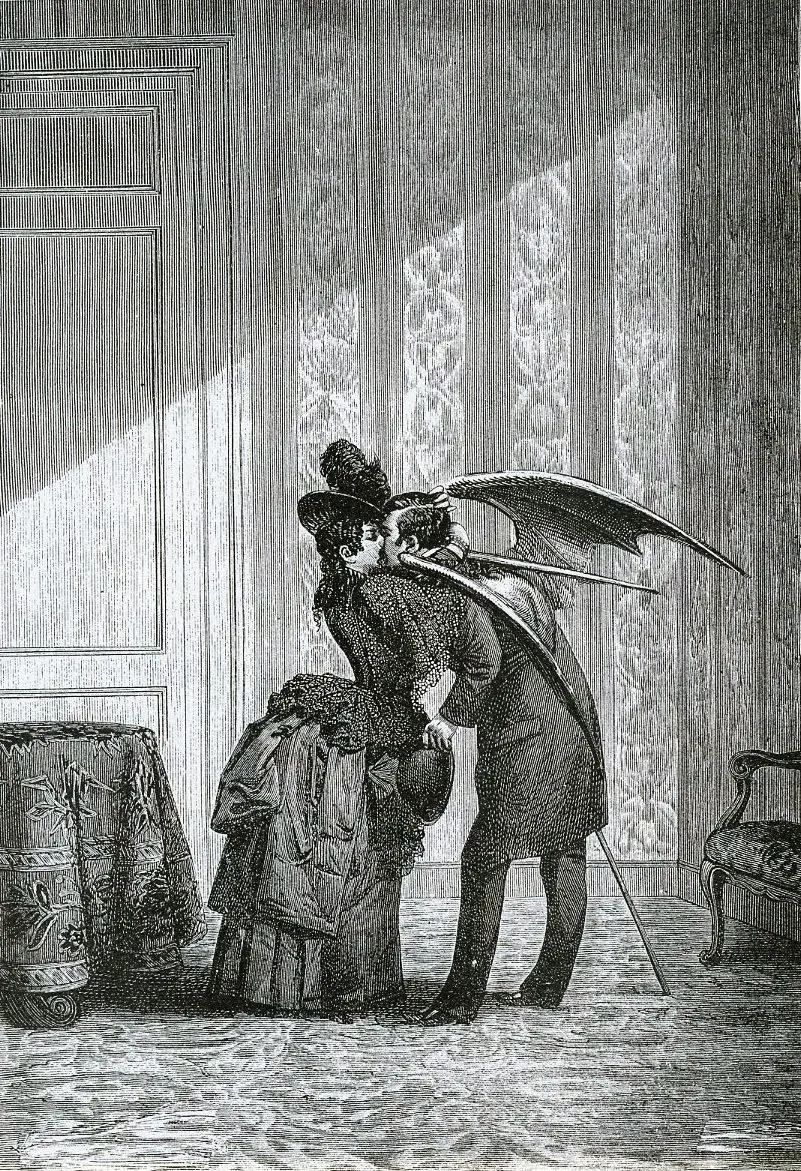
Max Ernst: Volume III: The Court Of The Dragon (An Illustration From 'A Week Of Kindness'), 1934
Witches
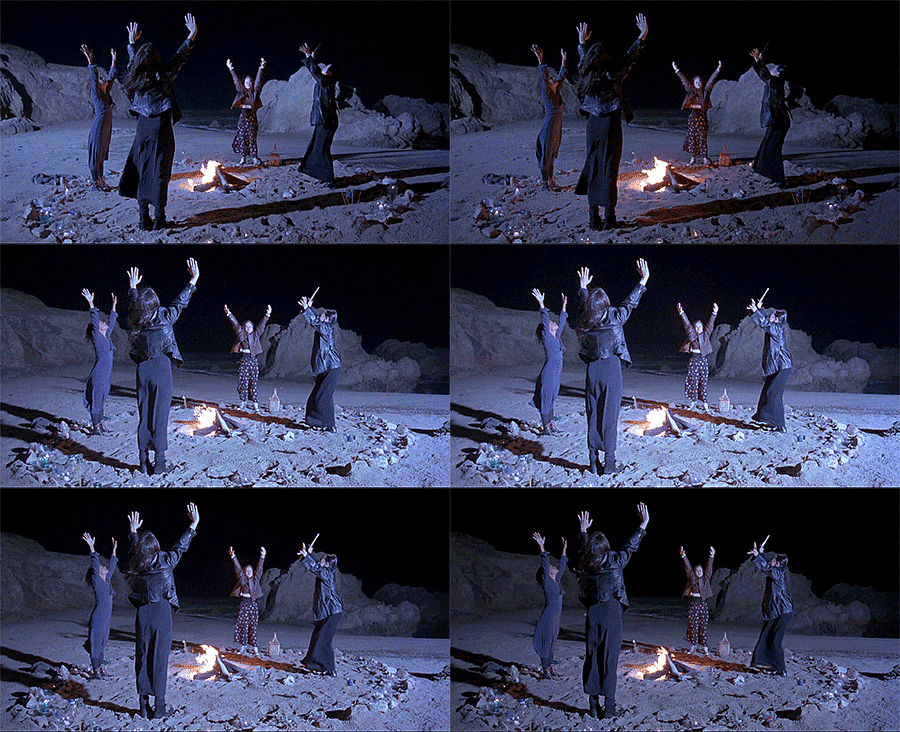
Witch lore encompasses thousands of years of global mythology, tracking the evolution of the "witch" from revered ancient healers and seers to persecuted outcasts. It spans deep-rooted folk traditions, evolving significantly through the Middle Ages and into the modern revival of Neopaganism.
Ancient Roots & The "Wise Woman" Long before the modern stereotype, early witches were the community's healers, midwives, and spiritual guides. They possessed a deep knowledge of herbalism, natural cycles, and the unseen world.
-Mythological Ties: Ancient magic often involved working with local spirits or deities. In classical antiquity, famous mythological figures like Circe were portrayed as enchantresses with the power to manipulate reality.
-The "Wise Woman": Society originally relied heavily on these practitioners for cures, baby deliveries, and agricultural counsel.
The Shift to the "Malevolent" Witch During the Middle Ages and early modern period (specifically the 15th to 17th centuries), the perception of the witch underwent a drastic, tragic shift.
-Demonic Pacts: Beliefs shifted from the practitioner of "natural magic" to someone who had made a pact with the Devil.
-The Witch Trials: Religious fervor and mass societal panic resulted in infamous historical events like the Salem Witch Trials and European inquisitions. Texts like the 1487 Malleus Maleficarum served as guides for identifying, prosecuting, and exterminating accused witches.
Core Folklore Tropes As the lore developed, several iconic tropes became cemented in cultural imagination:
-The Familiar: A witch's animal companion (often a cat, toad, or raven) that acted as a spirit helper or a medium to the supernatural.
-Broomsticks and Cauldrons: Witches were fabled to use brooms for midnight travel and cauldrons for brewing magical potions or herbal remedies.
-The Witches' Sabbath: Purported secret nocturnal gatherings where it was believed witches congregated to worship the Devil and cast curses.
Modern Witchcraft and Wicca Today, witchcraft lore is heavily influenced by the Neopagan and Wiccan movements, which emerged in the mid-20th century.
-Reverence for Nature: Modern Wicca, popularized by figures like Gerald Gardner, focuses on an empowering, nature-based spirituality, emphasizing balance with the earth.
-The Rule of Three: A fundamental ethical tenet in many Wiccan traditions, this law states that whatever energy a person puts out into the world (positive or negative) will be returned to them three times over.
Witchcraft
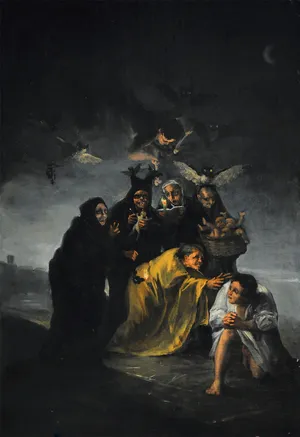
Francisco De Goya: El conjuro or Las brujas (“The Conjuring” or “The Witches”)
Witchcraft, term usually applied to harm brought upon others through the use of supernatural or occult powers. The person engaging in witchcraft is called a witch, while the act of causing harm may be termed cursing, hexing, bewitchment, or maleficium. A belief in malevolent witchcraft has been found across many societies throughout recorded history. Sometimes witches are believed to act alone and at other times to operate in tandem with other witches, often as part of a conspiracy opposed to the moral norms of their communities. While witches are often a product of imagination, folklore, and fiction rather than reality, in many cases there have been people who have tried to curse others and who in some instances might consider themselves to be witches.
In many places those accused of witchcraft have been ostracized, punished, and sometimes killed. A prominent example of anti-witch persecutions were the witch trials that took place in Europe and the American colonies during the early modern period (the 15th to 17th centuries), at which time Christian Europeans commonly regarded witches not only as individuals who cursed others, but also as Satanists who gathered at witches’ sabbaths to worship the Devil. In the 21st century the persecution of accused witches can be found in various parts of the world, including much of sub-Saharan Africa, Papua New Guinea, and central India. These persecutions, often called witch hunts, may be fueled by communal tensions and other social problems.
Over time, the terms witchcraft and witch have also gained alternative meanings among English language speakers. A second, far broader definition uses the term witchcraft to describe a varied range of ritual practices intended to manipulate occult, spiritual, or supernatural power regardless of intent. In this sense, witchcraft can be used to harm or to heal, allowing there to be both bad and good witches. A third use of the term witch describes a woman who is regarded as being antisocial, rebellious, or independent of male power, a usage that can be employed in either a misogynistic or a feminist manner.
The fourth definition characterizes several modern religious groups, largely of 20th and 21st-century origin, whose practitioners actively refer to their traditions as witchcraft and themselves as witches. Typically, these practitioners draw heavily on the imagery and terminology historically associated with witchcraft in European cultures but invest it with new meanings. The largest of these new religions is Wicca, although the identity of the witch is also adopted by some modern Satanists and other esotericists.
Witchcraft as harm
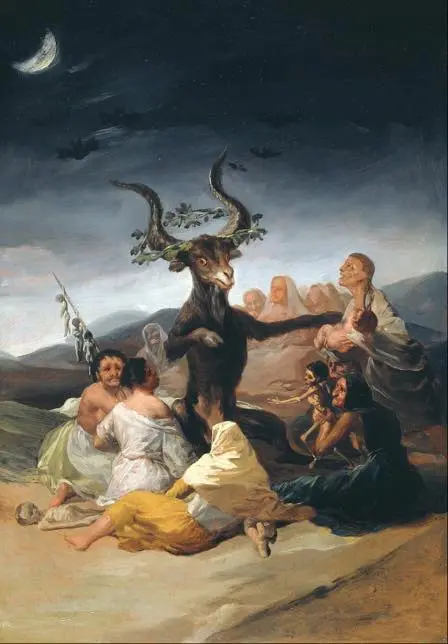
Francisco De Goya y Lucientes: The Witches Sabbath
The term witchcraft originated in the Early Middle Ages as the Old English term wiccecraeft. Prior to the 19th century the common understanding of the terms witch and witchcraft among English speakers was a negative one. In this context a witch was someone who drew on supernatural or occult power to harm others, engaging in what was often referred to using the Latin term maleficium.
Similar concepts were evident in many other parts of Europe, with terms roughly synonymous with the English word witchcraft including sorcellerie (French), Hexerei (German), stregoneria (Italian), and brujería (Spanish). As Europeans expanded across the globe from the 15th century onward, they encountered communities that also believed in individuals who harmed others through occult means. These communities often had their own names for this phenomenon, ranging from the Mapuche term kalkutun through to the Zande word mangu. In large part due to British colonialism and American cultural influence, at the start of the 21st century the English words witchcraft and witch are probably the best known terms for this phenomenon on an international level. However, given that these words carry considerable cultural baggage, it remains possible that future anthropologists might devise new terminologies for this cross-cultural belief in occult harming practices.
A common belief about witches is that they bring about their intended harm through the performance of ritual acts, in English typically termed spell-casting. Often this relies upon a belief in what the anthropologist James Frazer termed “sympathetic magic”—the notion that invisible connections exist between separate things sharing some particular commonality, and that performing an act with one of these objects will exert an impact on the other. A recurring idea throughout many parts of the world, including Polynesia, Melanesia, South Asia, Africa, and North America, is that witches can harm a person by gaining access to their nail clippings, hair, or bodily waste. Another idea, found in parts of Europe, is that a curse can be enacted by making a doll or effigy of a person, into which pins can then be inserted.
Not all witches need to perform ritual acts in order to curse somebody, however. Especially common in West and Central Africa and Melanesia are various beliefs about witches who bring about harm simply through their thoughts or desires. A similar notion, particularly recurrent in North Africa and the Middle East, is that of the evil eye, the idea that an individual can curse another through the power of sight alone.
Some communities have believed that individuals make a conscious choice to practice witchcraft, but elsewhere can be found the belief that certain people are simply born witches and may have little control over their actions. A traditional belief among the Bangwa of Cameroon, for instance, is that witches are born with an extra organ that compels them to drain other people’s blood. Similarly, an idea recorded among the Nyakyusa of Tanzania is that each witch inherits a python living within their stomach, which drives them to consume human flesh. This association with particular animals can also be seen in other contexts. Among the Zulu of South Africa, a traditional belief maintains that certain types of witches ride naked upon baboons, while in early modern England, a common notion held that witches were assisted by familiars, demonic entities that took animal form.
Witches are sometimes believed to act alone, but in other cases they are instead thought to operate in tandem with others, often as part of a secret society. The Kongo people of Central Africa are among those who traditionally believe that witches meet together to perform their nefarious acts, while from the Hopi of the American Southwest has been recorded the notion that witches all over the world form an international network and share a common language. In many cases this society of witches is regarded as being fundamentally anti-social and opposed to the moral norms of their communities. For this reason, witches are often thought to gather at night, when most people are asleep, and to engage in acts generally regarded as being socially taboo, such as nudity, cannibalism, and incest.
As part of the worldview of many different communities, witches have often been incorporated into folk tales and legends. Internationally the best-known of these are probably the witches that feature in German tales such as “Hansel and Gretel” that were recorded and published by the Brothers Grimm in the early 19th century. The notion of malevolent witchery has also entered popular culture, with witches of this kind appearing in various influential works of fiction, ranging from literature such as William Shakespeare’s Macbeth (c. 1606) and Roald Dahl’s The Witches (1983) through to films like Suspiria (1977) and The Blair Witch Project (1999).
Witchcraft as a morally neutral term
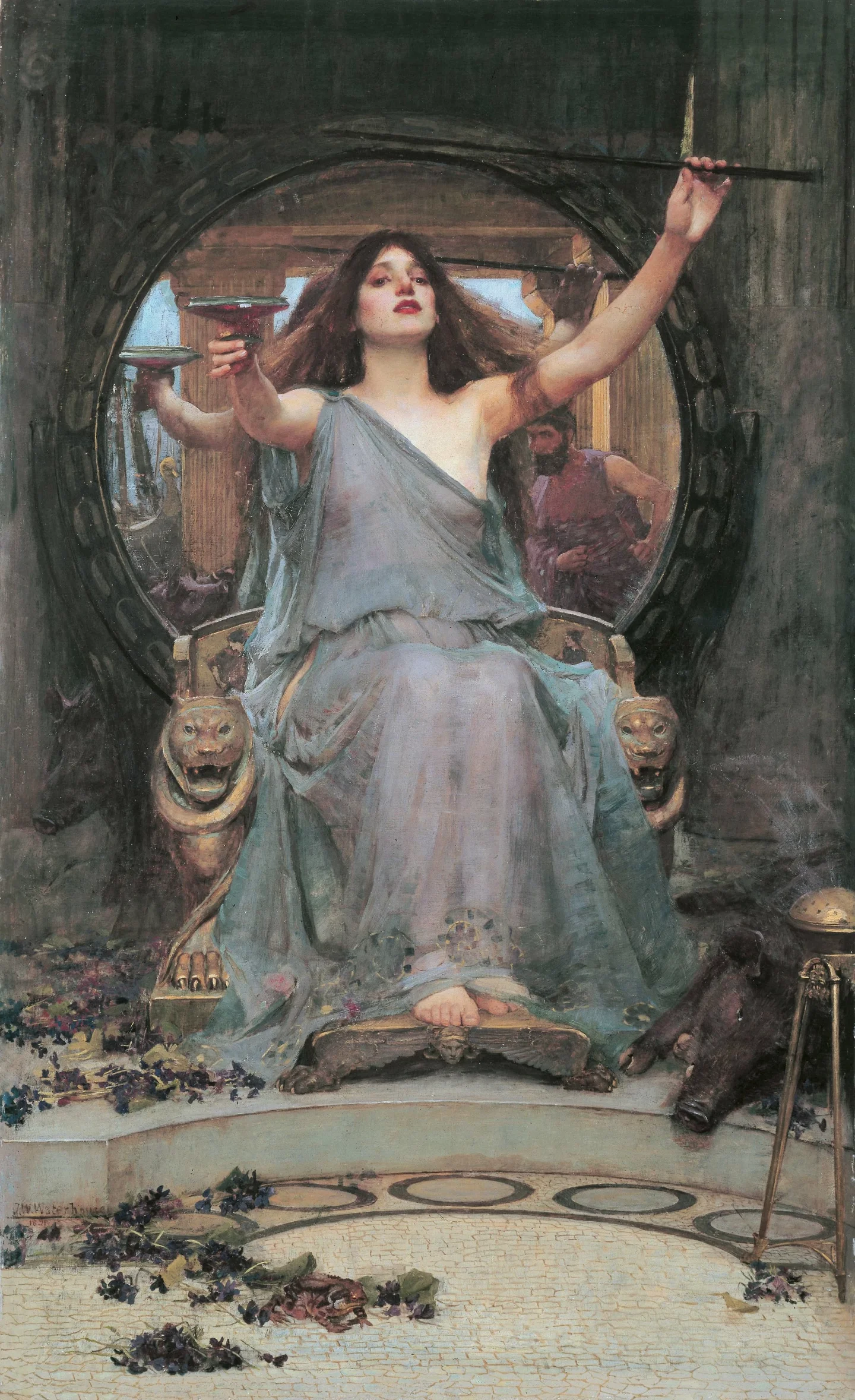
John William Waterhouse: Circe Offering The Cup To Ulysses
Many English language words have seen their meanings shift over time—something that is certainly true of witchcraft and witch. A second, far broader understanding of the term witch has come to encompass a varied range of people thought to manipulate supernatural or occult forces regardless of their intentions in doing so. Under this definition, witchcraft can be used not only to describe someone using these powers to curse another, but also for those manipulating such forces to provide healing, to engage in divination, or to lift the curses of others. In this sense, witchcraft is not always malevolent but can be for benevolent reasons too; thus, there can be good witches as well as bad ones.
The morally neutral use of the word witch has gained particular traction in fiction. An early and prominent example was L. Frank Baum’s 1900 novel The Wonderful Wizard of Oz and its 1939 film adaptation, in which the imagined Land of Oz is home to both good witches and bad witches. In the late 20th and early 21st centuries, morally benevolent witches have become widespread in fantasy fiction, as in Terry Pratchett’s Discworld books, Jill Murphy’s The Worst Witch, or J.K. Rowling’s Harry Potter series. The increasing popularization of the idea that witches can be good in turn contributed to growing numbers of people who actively considered themselves to be witches.
Modern religious witchcraft
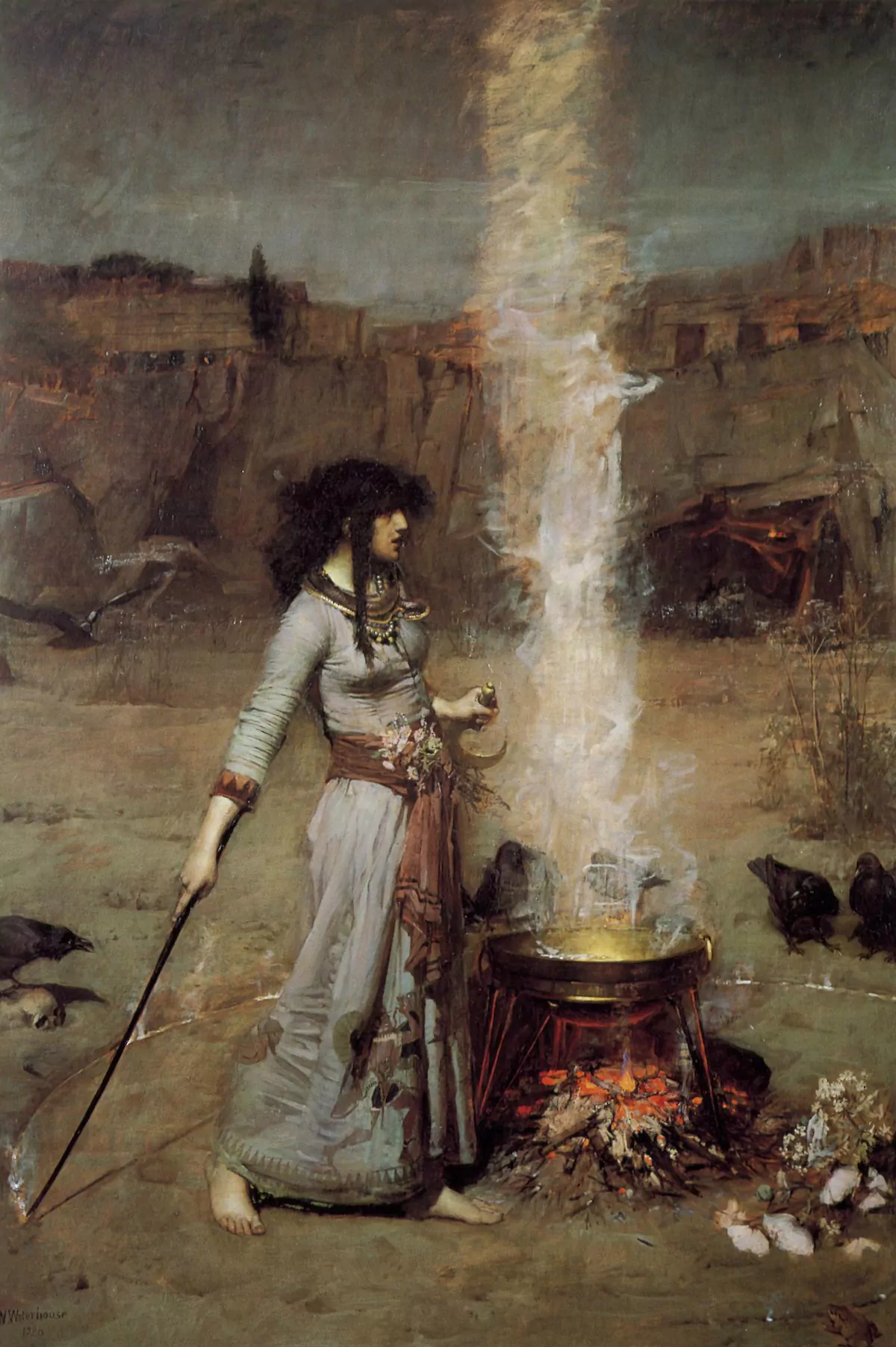
John William Waterhouse: The Magic Circle, 1886
From at least the early 20th century various individuals living in Europe and European-descended communities elsewhere have referred to themselves as witches and their religious practices as witchcraft. In embracing the identity of the witch, these people have adopted a counter-cultural stance to differentiate themselves from the Christian-dominated societies in which they typically reside. The embrace of the witch as a self-identity was probably facilitated by the spread of the secondary definition of witchcraft, that of it being a morally neutral practice, which was seen particularly in literature. At the same time, the emergence of modern religious witchcraft was only possible due to the dramatically declining belief in malevolent witchery within most Anglophone Western societies. With fewer and fewer people believing that curses really worked, it became less and less likely that those calling themselves witches would face criminal prosecution or violent persecution from their neighbors.
The largest and most prominent of the contemporary religious witchcraft traditions is Wicca, a modern Pagan religion that first came to public awareness in 1950s Britain. Early Wiccans typically believed that theirs was an ancient pre-Christian religion that had survived into the 20th century, a notion later refuted by historical scholarship. Many Wiccans now recognize that theirs is a new religion devised largely by British esotericists in the late 1940s and early 1950s. Wiccan beliefs and practices nevertheless draw heavily on the rhetoric and imagery of early modern witchcraft, and its practitioners typically consider themselves witches. Wiccan groups are called covens, engage in spell-casting, and celebrate seasonal festivities they call Sabbats. A Paganized version of the Devil appears in the form of the horned god, often part of a duotheistic theology alongside a goddess. The number of Wiccans is now in the low hundreds of thousands, with a large proportion practicing the religion solitarily rather than in a group setting.
Several other religious groups also adopted the identity of the witch. LaVeyan Satanism for instance emerged in 1960s California, established by Anton LaVey, who referred to his male followers as warlocks and their female counterparts as witches. His was formally an atheistic tradition, regarding Satan as a symbol for humanity’s animal nature. Like Wiccans, LaVeyan Satanists similarly engage in spell-casting within ceremonial frameworks. By the 1990s there were also a growing number of esotericists, some organized into small groups, calling themselves traditional witches. They often emphasized an aesthetic drawing on rural European folklore and developed new approaches to the iconography of early modern witchcraft beliefs, for instance espousing the idea that the witches’ sabbath existed on an astral plane that could be visited in a dream state.
Growing teenage involvement in modern religious witchcraft was also evident by the 1990s, largely influenced by Wicca and fueled by American television shows like Buffy the Vampire Slayer (1997–2003) and Charmed (1998–2006). These productions typically presented witches not as old crones but as young women balancing their witchcraft with everyday life in more-or-less real-world, contemporary settings. Renewed teenage interest in modern religious witchcraft was further encouraged by social media beginning in the mid-2010s, most famously through the “WitchTok” hashtag on video hosting service TikTok.
The identity of the witch has also been adopted by some individuals practicing African diasporic traditions, those religions resulting from the forced transportation of West and Central Africans to the Americas. For several centuries, European observers have labeled these traditions with pejorative terms like witchcraft, magic, and superstition. In turn, by at least the late 20th century, some practitioners of these traditions had reappropriated the identity of the witch, especially through its Spanish synonym bruja. This can be seen among certain spirit mediums practicing Espiritismo in Puerto Rico, as well as among initiates of Palo, a Cuban religion influenced heavily by Kongo traditional practices. In the case of Palo, certain practitioners command the spirits of the dead to attack others, bringing such a practice within the traditional definition of malevolent witchcraft. By the mid-2010s, embrace of the term witch was also increasingly evident among practitioners of Hoodoo or Conjure, the traditional African-American healing and hexing system. This reflects the ongoing popularization of the term witch and its ever-growing conceptual expansion to include more and more practices within its remit.